
Dynamic Content: Collections & External Connections
Collections are an essential part of customized dynamic content solutions, such as dynamic pages. They function like databases that store lists of items with the same type of information (such as name, location, image, etc.). Collections serve as the data source, enabling the automatic display of updated content on dynamic pages or across your site when using collections on regular pages. While built-in features like blogs also use dynamic content, collections are critical for customized dynamic content solutions.
There are four types of collections (see Collection Types in this article). While collections are essential for dynamic pages, they can also be used on regular pages. For more information, see: Dynamic Pages and Collections for Regular Pages
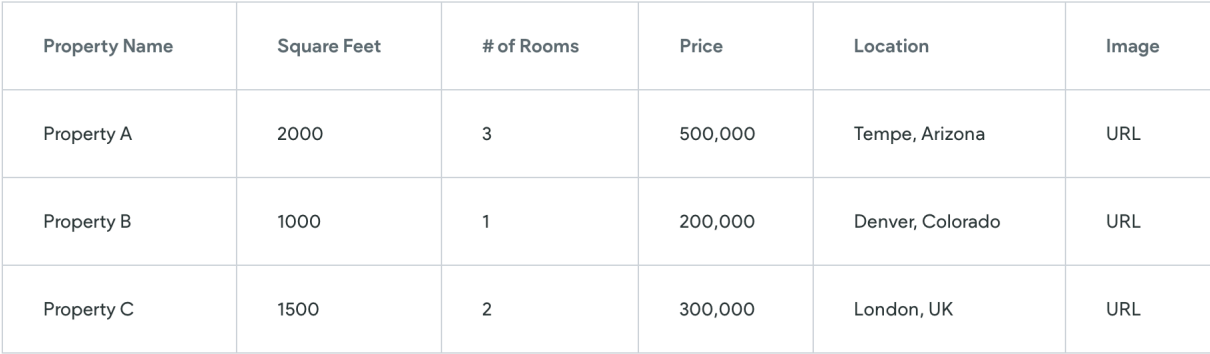
For example, a collection might contain information about properties available to rent:
Collection Types
You can create many types of collections.
- [Dynamic Content: Internal Collections (stored in the editor)
- Dynamic * Content: Google Sheets Collections
- Dynamic Content: Airtable Collections
- Dynamic Content: External Collections in this article
Collection Guidelines
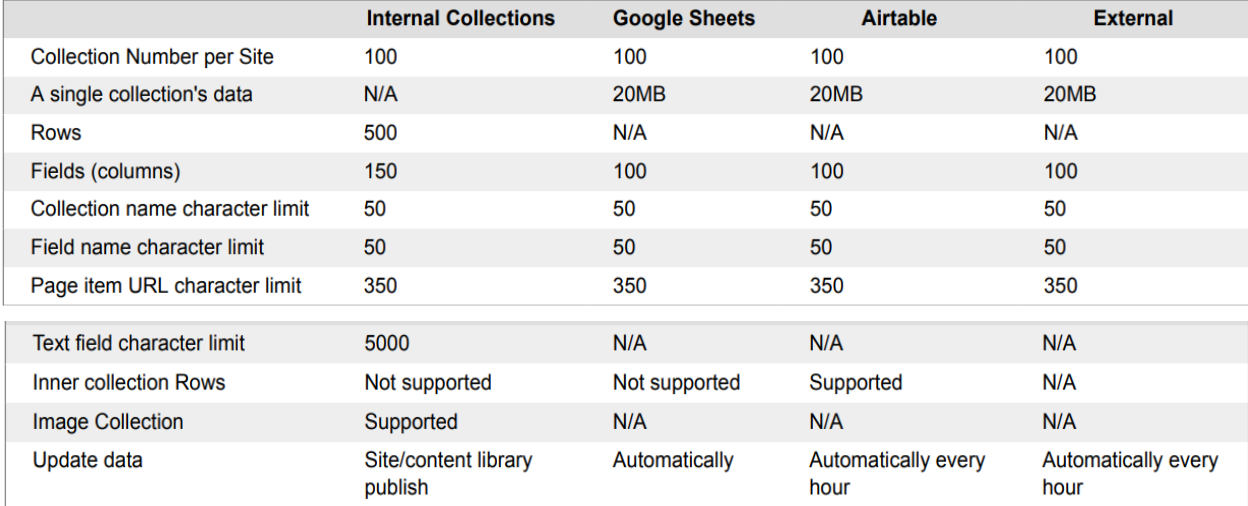
Limitations and Specifications per Collection Type
Essential Formatting Guidelines
All collections should adhere to the following guidelines:
- Field Names. The first row of the collection must contain the field names (for example, Number of Rooms).
- Data Type. Data must be structured correctly based on the data type.
- URL Field. Must be formatted as a string and only supports lowercase characters, numbers, dashes and underscores. Special characters are not supported.
- Page Item URL Field (Airtable and Google Sheets). You must select a field from the Page item URL drop-down in the collection to define the URL of each page and what appears in the editor dropdown. If you already have a text field named page_item_url in your collection, it will automatically be mapped to this drop-down. If this field is not defined, page URLs are assigned numbers (Google Sheets) or a random string (Airtable).
- Page Item URL. It is recommended the URL be in a URL format (for example this-is-an-example). The URL cannot contain special characters.
- Business Hours. To use Business hours you must use the following specific structure in a text field (field type: business hours):
SAT, SUN: 08:00-20:00; MON, FRI: 08:00-12:00; - Location. To use Location you must use the following specific structure in a text field (field type: location):
String - streetAddress, postalCode, region, city, country
846 Kerry Way, 90017, CA, Los Angeles, USThe geo location is calculated from this string, the postal code is not mandatory but if the address is not written correctly (typos for example) we might not find it. - Nested Pages (Page Item URL; Airtable and Google Sheets). Collection names and URLs cannot contain nested pages for Airtable or Google Sheets. For example, you cannot use a page item URL with the structure example/subpage. This is supported for Internal Collections.
Available Fields
Below is a table with the data types that are available.
NOTE
For further details and data examples for specific collections types, please see their articles (Internal Collections], Dynamic Content: Google Sheets Collections, and Dynamic Content: Airtable Collections
| Data Type | Uses and Notes |
|---|---|
| Plain Text | Standard text, can be used for widgets such as title tags and text widgets. |
| Rich Text | Rich text contains formatting, such as colors, styles, and links. Please note, rich text will come over differently per collection type |
| Image | This type is for a single image only. Please note that the input methods are different per collection type |
| Link | Pages will result in a 404 error if the URL contains a space at the beginning or end. |
| Number | Standard number. Can be whole numbers or decimals. |
| Date & Time | This field can be used for sorting when using the filters or sort functionality in the Connected Data pop-up. |
| Business Hours | Please note that the input methods are different per collection type. |
| Location | Please note that the input methods are different per collection type. |
| Video | Added with a link (Vimeo, YouTube, and Dailymotion videos are supported (videos uploaded to the editor, aren't able to be used in collections). |
| - | |
| Phone | - |
| Social Accounts | Supported social networks: email, whatsapp, facebook, twitter, instagram, youtube, linkedin, yelp, pinterest, google_my_business, waze, vimeo, snapchat, reddit, tripadvisor, foursquare, rss. Please note that the input methods are different per collection type. |
| Multi-Select | This field can be used to filter the displayed collection in widgets, such as photo gallery, list, accordion, and custom widgets that connect to collections. Please note that the input methods are different per collection type. |
| Inner Collection | Only available for Airtable collections |
| Image Collection | Only available for Internal Collections |
Add a Collection to a Site
To add a collection to a site:
- In the side panel, click Content.
- Click Collections, then click +New Collection.
- Select the type of collection you want to create.
- When adding a Google Sheet or Airtable collection, define the correct data type for each field.
Dynamic Content: External Collections
External collections can serve as a collection allowing you to create Dynamic Pages as well as enhance regular pages. Using a collection on a regular page is similar to how Connected Data is used with the site's Business Info.
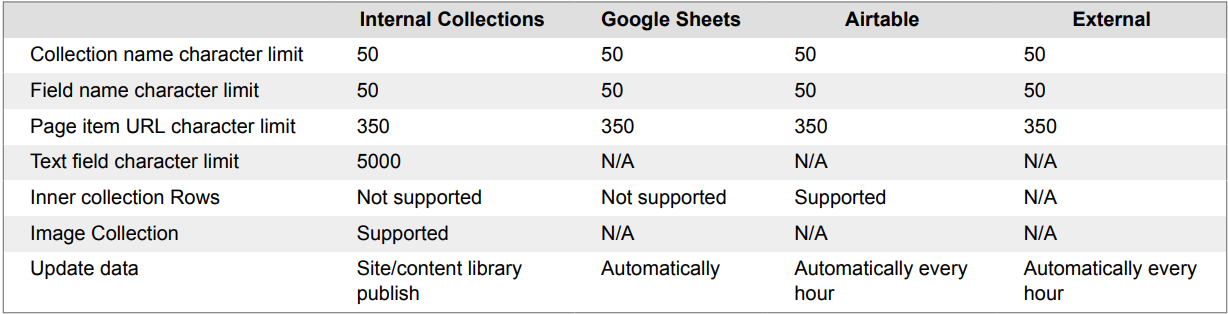
Limitations and Specifications per Collection Type

Connect to an External Database
To connect to an external database:
- In the side panel, click Content.
- Click Collections.
- Click + New Collection, and select External Database.
- Type the Endpoint URL and click Fetch collection.
- Click Continue.
- Type a name for the collection.
- Select the correct data type for each field in the collection.
- (Optional) Add additional fields.
- Click Continue.
- Import the collection.
Set External Collection Sync Frequency
By default, external collection data is synced every hour. However, due to API call limits on different platforms, this can quickly deplete available calls and lead to service disruptions. To prevent this, you can set how often your external collection data is synced. This allows you to ensure you do not exceed the amount of API calls your external collection platform allows.
To set how often external collection data is synced:
- In the side panel, click Content.
- Click Collections and open the desired external collection.
- At the top of the external collection under Sync data every, use the arrows to select a number, then use the dropdown menu to select either Hours or Days. By default, Automatic is selected. This is the default and means your collection data is synced every hour.
Note that the sync timing only applies to the current external collection. You must set each external collection sync timing individually.
- Click Save.
Updated 3 months ago