
Site Theme
Site Theme
The Site Theme panel lets you make changes that affect your entire site. You can customize your site's
text, buttons, images, background, and navigation widgets from the design panel. This allows you to
quickly and efficiently make sweeping visual changes, reducing design time and keeping your site's
style consistent across pages.
To open the Site Theme panel, in the side panel, click Theme. When the Site Theme panel is open, the
canvas is automatically minimized to 50% view so that the entire canvas is visible while adjusting the
site theme settings. If you want to return to 100% canvas view, click the drop down in the top bar and
select 100%. The ability to zoom in or out is also available in preview mode.
📘 NOTE
- Changes that you make to specific widgets or pages will override themes set in the
Site Theme panel. We recommend you first decide on a site theme, and then make
customizations to parts of your site that you want to stand out or look different than
the rest.
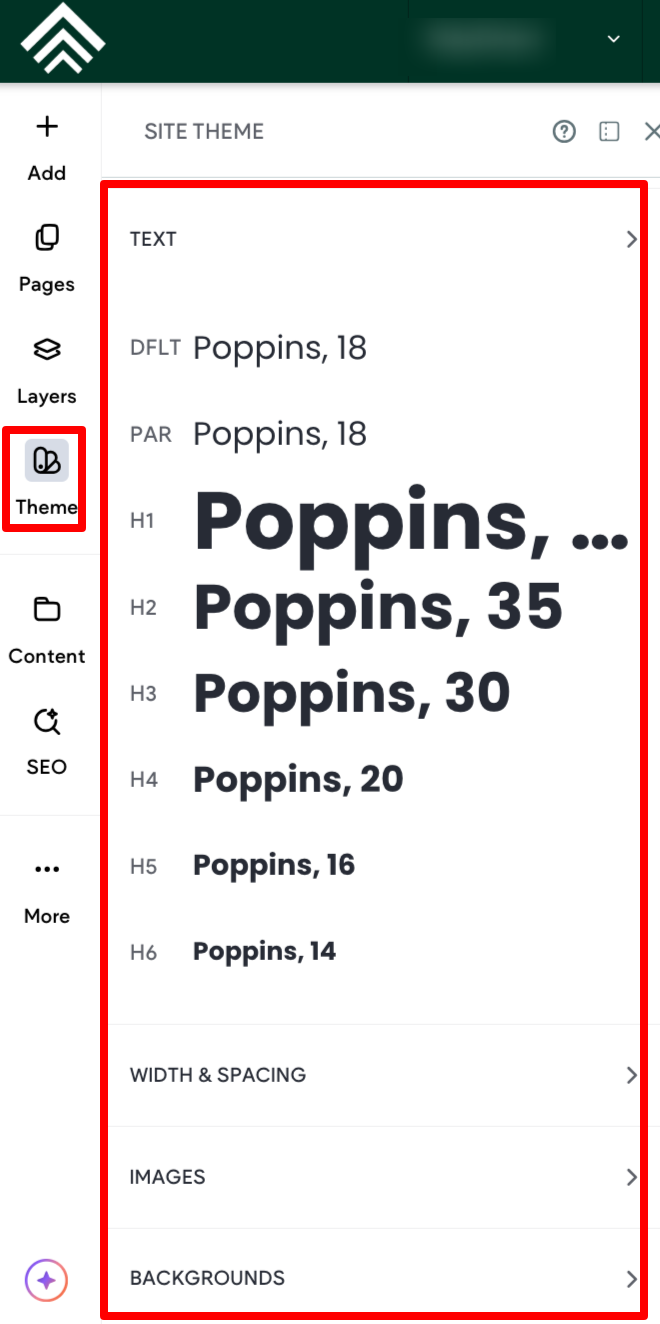
Theme Text
This section lets you control text for your site, both for text and headings of all sizes (H1 to H6). Change
the style and look of the text on your entire site. You can change font type, size, and also choose
settings for normal text, links, and titles.
Changing the font size, style, color, and other edits will affect future paragraphs, and other text types as
well as current widgets connected to Site Text that have not been manually changed.
Configure Theme Text
To configure theme text:
- In the side panel, click Theme.
- Click the arrow next to Text.
- Click the desired text type. The options are:
- DFLT. This will set the theme for all text in widgets that are not assigned to a heading or to
the paragraph style such as the navigation widget. Link text color and underline can also be set
here. Additionally, you have the option to customize the appearance of links for different states,
including the Default Link State, Link On-hover, and Link Clicked.
- PAR. This will set the theme for the text widget.
- Heading and subheadings H1-H6.
- You can change the following per text type:
- Font
- Font size. This is set for desktop/tablet and mobile, separately.
- Scale text. (Editor 2.0 only) When enabled, the text scales based on the parent container's width.
This can be helpful if you do not want a line break in a heading. Widgets with text that are
connected to the theme will inherit this setting, however the setting can be overridden per widget.
- Font color
- Font format
- Text direction
- Font weight
- Line height
- Letter spacing
- All caps
- Text shadow
Making changes in the Theme text area changes all text in the site that is not overridden by individual,
custom style changes. When manual edits are made to individual elements it overrides the site theme
and any changes made to the site theme will no longer affect the style of these elements. This is at the
individual style settings of a certain site element, for example, if you only changed the color of the text in
a particular H1 widget on the canvas:
- And then changed the font size of H1 in the site theme, the H1’s font size will still change in the H1
widget.
- And then changed the color of H1 in the site theme, the H1 that had been changed will not update
with the color change.
Update Theme Text
You can update theme text in the text settings by clicking Theme, then selecting Text. Or, you can
click a text widget to open the context menu, click the heading selection drop down, and select Update
theme. This opens the theme text settings where you can make updates.
Fonts Library
The editor features a variety of fonts for your use. Set a theme text font or choose to differentiate your
text by using multiple different fonts on your site.
To view available fonts and see what they look like:
- In the side panel, click Theme.
- Click Text.
- Select a font from the Font drop down menu.
Theme Colors
Colors allow you to define a color palette and link the individual colors to any or all widget with color
settings. The color of any element that is linked to the theme colors will automatically be updated when
the linked color is changed in the theme colors settings. This allows you to quickly make color changes,
which helps reduce design time and ensures your site's style is consistent across pages.
Account owners automatically have Editor permissions and can edit, view, and use theme colors. Team
members and clients who do not have Editor permissions can view and use theme colors, but they
cannot edit them.
Configure Theme Colors
You can configure up to 20 theme colors.
To configure theme colors:
- In the side panel, click Theme.
- Select the arrow next to Colors.
- Click the Plus icon next to Primary, or whichever setting you need to define.
- Type the HEX or RGB value of the desired color, or use the eye dropper tool to select a color.
- (Optional) You can generate colors from your logo. Click to open the primary color, then *open the
Brand tab* and click + Add Logo (if you added a logo to your Business Info in the Content Library,
it will appear here). After adding your logo, a set of colors is generated.
If you need to remove or replace the logo, click the three dot icon next to your logo and select
either Remove or Replace Image. Note that you need Content Library & Business Info permission
to upload, remove, or replace the logo.
Repeat these steps as necessary for each theme color. Next, you need to connect the colors to widgets
on your site.
Automatically Configure Theme Colors
If the site or template doesn't have colors already connected, it can be done automatically. The automatic theme colors generator scans your site and detects the most frequently used colors. It generates
a list of colors to select from, and once selected, those colors become your theme colors and are
connected to your site widgets.
To automatically configure theme colors:
- In the side panel, click Theme.
- Select the arrow next to Colors.
- Click Set Theme Colors.
- Click Connect it for me or I'll connect it myself.
- (Optional) If you selected I'll connect it myself, click the Plus icon next to each color in the design
panel and select the colors individually.
- Select which of the generated colors you want to use.
- Click Save & Connect Colors.
The colors will populate in the Colors section of the Site Theme panel.
Connect Theme Colors to Widgets
To connect a widget to a theme color:
- Click a widget to open it’s settings menu.
- Open the color settings and select one of the theme colors listed at the top.
- Repeat as necessary for other elements.
- (Optional) If you need to edit one of the theme colors, click the pencil icon and the theme colors
settings will open where you can edit the desired color.
Once a widget is connected to theme colors it will automatically update when the linked theme color is
updated.
Rename Theme Colors
To rename theme colors:
- In the side panel, click Theme.
- Click Colors.
- Hover over the desired color name and click the pencil icon.
- Type a new name.
The new name is automatically saved and will appear when hovering over the color in the color picker.
Remove Theme Colors
You can disconnect any widgets connected to individual theme colors.
To disconnect a widget:
- In the side panel, click Theme.
- Click Colors.
- Click the three horizontal dot icon next to the Colors text and *select Remove theme
colors*.
- Select which colors to remove, then click Remove Selected Colors.
Site Buttons
This section lets you define the style of primary and secondary button widgets on your site. Select
one of our button layouts and set the text, background color, border, hover state, corners, and shadow
styles.
To hide the Back to Top button on mobile, enable the toggle in the Site Layout section.
Theme Images
This section lets you control the style of the image widgets on your site. You can change the image
layout, add or edit the border style, rounded corners, or shadow effects.
Theme Background
This section lets you control Background style for your site. Choose between using a color or image
as your background. Choose a custom background image from the photo gallery or upload your own
images to add a unique site design. Changes also affect the desktop and tablet.
Customize Site Background
To customize your site background:
- In the side panel, click Theme.
- Click the arrow next to Backgrounds.
- Click Default Background.
- Click either the Color or Image tab or select a color for the site background or upload an image.
- (Optional) Click the Do not optimize this image toggle to prevent optimization (this setting will
appear after an image has been selected).
Customize Background Per Page
To customize the background per page:
- In the side panel, click Theme.
- Click the arrow next to Backgrounds.
- Click Background per page.
- Select a page from the drop-down menu, and select image or color for the specific page.
- (Optional) Click the Do not optimize this image toggle to prevent optimization (this setting will
appear after an image has been selected).
Updated on: 12/05/2026
Thank you!